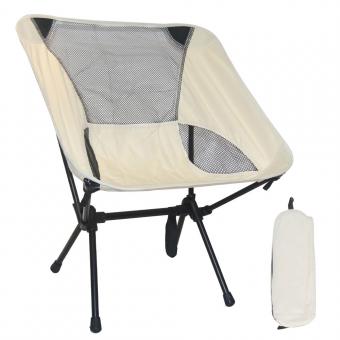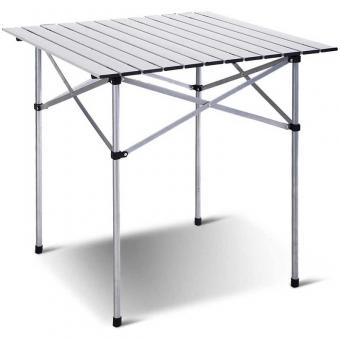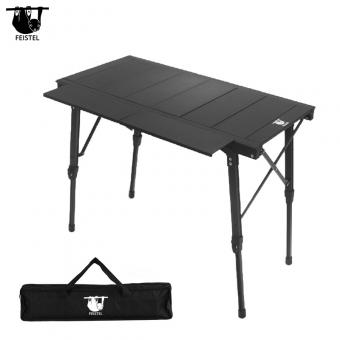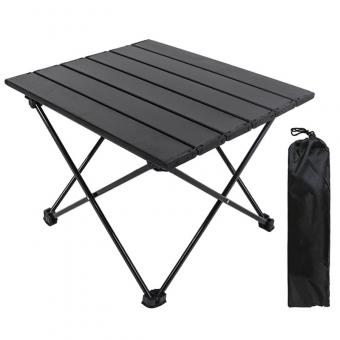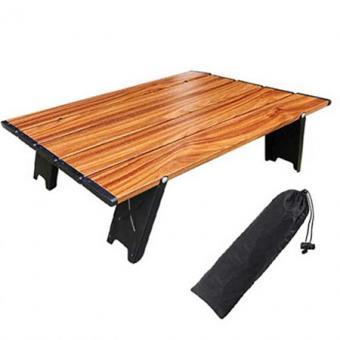
軽量小型屋外折りたたみピクニックテーブル
ブランド:安徽省FEISTEL FACTORY 関連製造: OEM & ODM 商品名:アウトドアに最適な軽量、小型、折りたたみ可能なピクニックテーブル。耐久性のある素材で作られており、持ち運びが簡単で、セットアップも簡単です。
ニール私たちのウェブサイトへようこそ!
もっと詳しく知る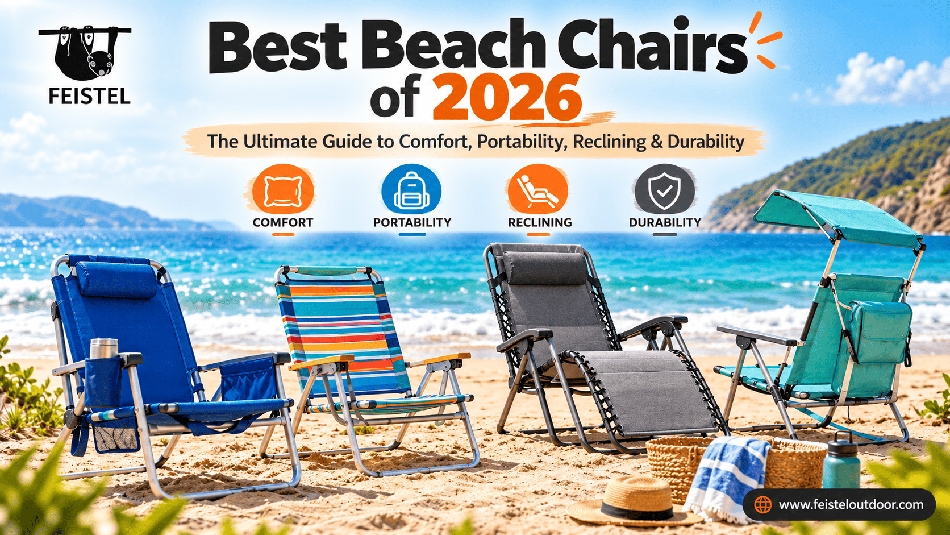 Quick Summary: Best Beach Chairs of 2026
Choosing the best beach chair in 2026 involves more than finding an attractive folding seat. A suitable beach chair must combine comfortable support, practical portability, reliable construction, and compatibility with the environment in which it will be used.
At FEISTEL, we approach outdoor seating from the perspective of product development and manufacturing. As a manufacturer of camping furniture and portable outdoor products, we consider how structural geometry, frame materials, textile construction, folding systems, dimensions, and intended use contribute to the overall performance of a chair.
Beach chairs may encounter loose sand, compacted wet sand, direct sunlight, salt-containing moisture, uneven ground, and repeated transportation. A design that works well on a firm campsite surface may behave differently when placed on soft sand. Similarly, a chair that feels comfortable during a short demonstration may not provide the same experience during an extended beach outing.
For this reason, we do not believe that the best beach chair can be identified through appearance, advertised weight capacity, or price alone. A lightweight beach chair may suit travelers, a reclining chair may better suit extended relaxation, and a higher folding chair may provide easier entry and exit for some users.
Throughout this guide, we distinguish peer-reviewed scientific findings, FEISTEL product specifications, and characteristics requiring product-specific testing. This is a research-informed buying and design guide, not an independent laboratory ranking of every chair available in 2026.
Beach chairs come in several configurations, each balancing seating position, portability, comfort, and functionality. Rather than assuming that one design is universally superior, we recommend first identifying the type that matches the intended activity.
Lightweight folding chairs emphasize transport and storage; low-profile chairs emphasize relaxed seating close to the sand; reclining chairs allow changes in posture; high-back chairs offer taller supporting surfaces; wooden chairs contribute a traditional furniture appearance; camping-style chairs offer broader outdoor versatility; padded chairs soften contact surfaces; and beach mat loungers provide ground-level relaxation.
These categories overlap. A lightweight folding chair may also be low-profile and reclining. Buyers should compare actual seat dimensions, chair weight, packed size, frame material, textile construction, rated capacity, and ground-contact geometry rather than relying on marketing labels.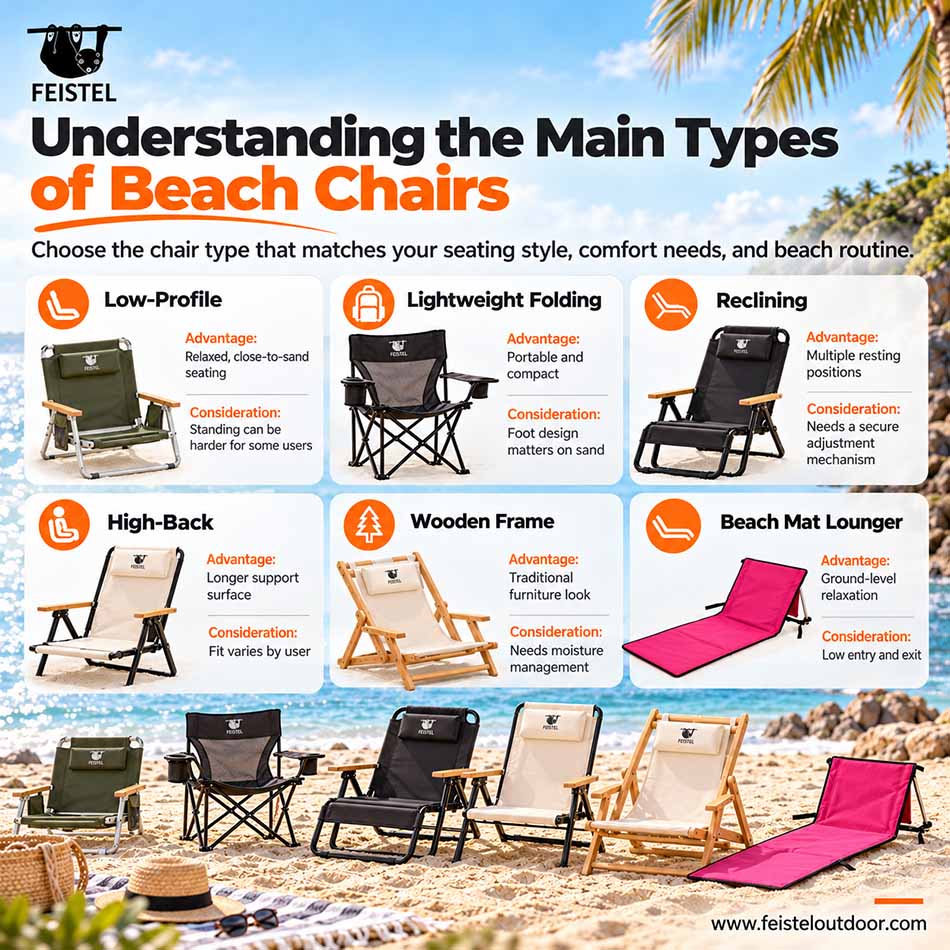
| Beach chair type | Main advantage | Important consideration |
|---|---|---|
| Low-profile | Relaxed, close-to-ground seating | Standing may be harder for some users |
| Lightweight folding | Portable and compact | Ground-contact design matters |
| Reclining | Multiple resting positions | Secure adjustment mechanism |
| High-back | Longer supporting surface | Fit varies with body dimensions |
| Wooden frame | Traditional appearance | Finish and moisture management |
| Beach mat lounger | Extended ground-level resting | Low entry and exit |
Lightweight beach chairs are useful when people transport towels, umbrellas, coolers, and other equipment. However, portability cannot be reduced to weight alone. Packed length, carrying system, and the number of setup steps also influence convenience.
Aluminum alloys are widely used for portable outdoor furniture because they support relatively lightweight structural designs. Some compact chairs use 7075 aluminum, a high-strength alloy in certain tempers. Its designation alone does not establish finished-chair durability or marine corrosion resistance; frame geometry, wall thickness, joints, surface treatment, and fasteners also matter.
Our lightweight low-profile adjustable chair configuration illustrates the combination of a compact frame and multiple seating positions. Published specifications have described an approximately 1.4 kg weight, 40 × 13 cm packed size, and a 150 kg stated capacity. These values should be confirmed against the current model specification and the relevant capacity test before publication as a verified performance claim.
For beach use, buyers should evaluate the contact geometry of chair feet on the intended sand conditions. A portable chair should work well across the entire experience of carrying, opening, using, folding, cleaning, and storing.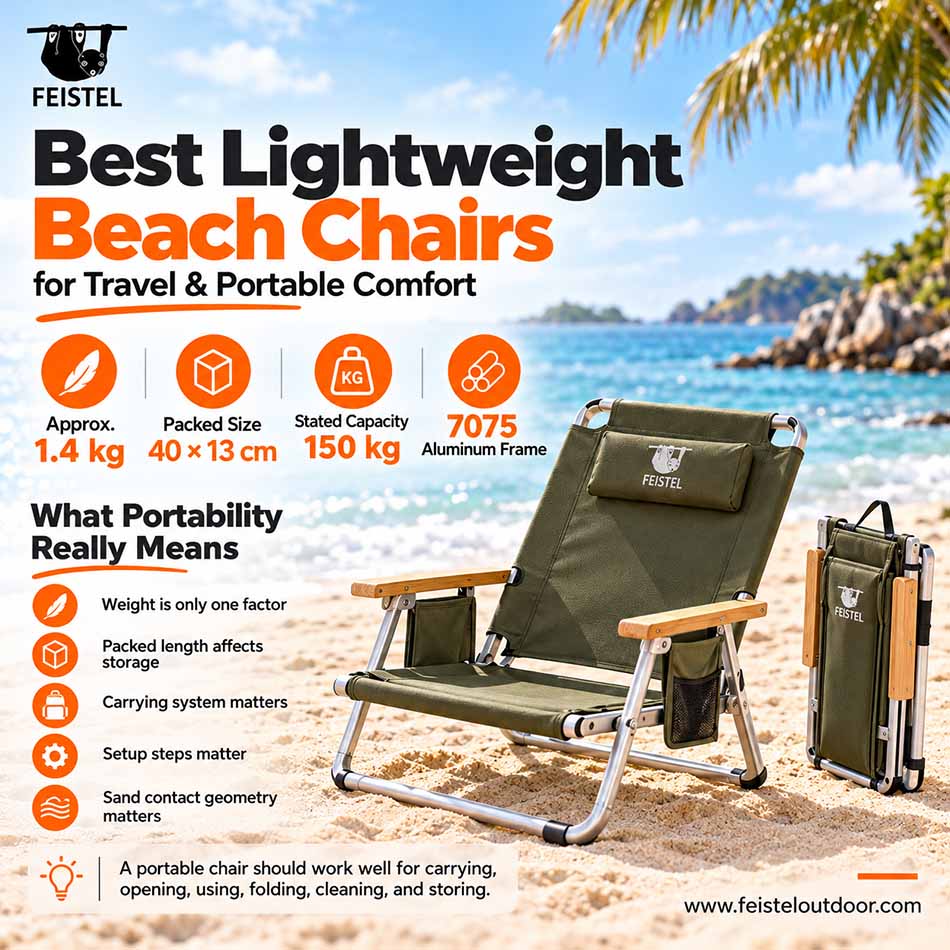
Reclining beach chairs support several resting positions, which can be useful for reading, conversation, and relaxation. The number of positions is not itself proof of superior comfort.
We treat reclining design as an interaction among backrest angle, seat-pan inclination, user posture, support geometry, and the locking mechanism. Research on the relationship between seat and back angles suggests that changes in geometry can alter shear forces at the seat-body interface. The preferred angle is not necessarily the angle with zero shear force. [5]
A reclining system should engage securely, operate predictably, and avoid unnecessary pinch-point exposure. Repeated adjustment introduces mechanical wear that may require product-specific validation.
Our Reclining Camping Chair – 350 lb Folding Beach Recliner is an example of a steel-frame, Oxford-fabric recreational reclining configuration. The published rated capacity should be verified under the applicable test conditions rather than interpreted as evidence of unlimited dynamic durability.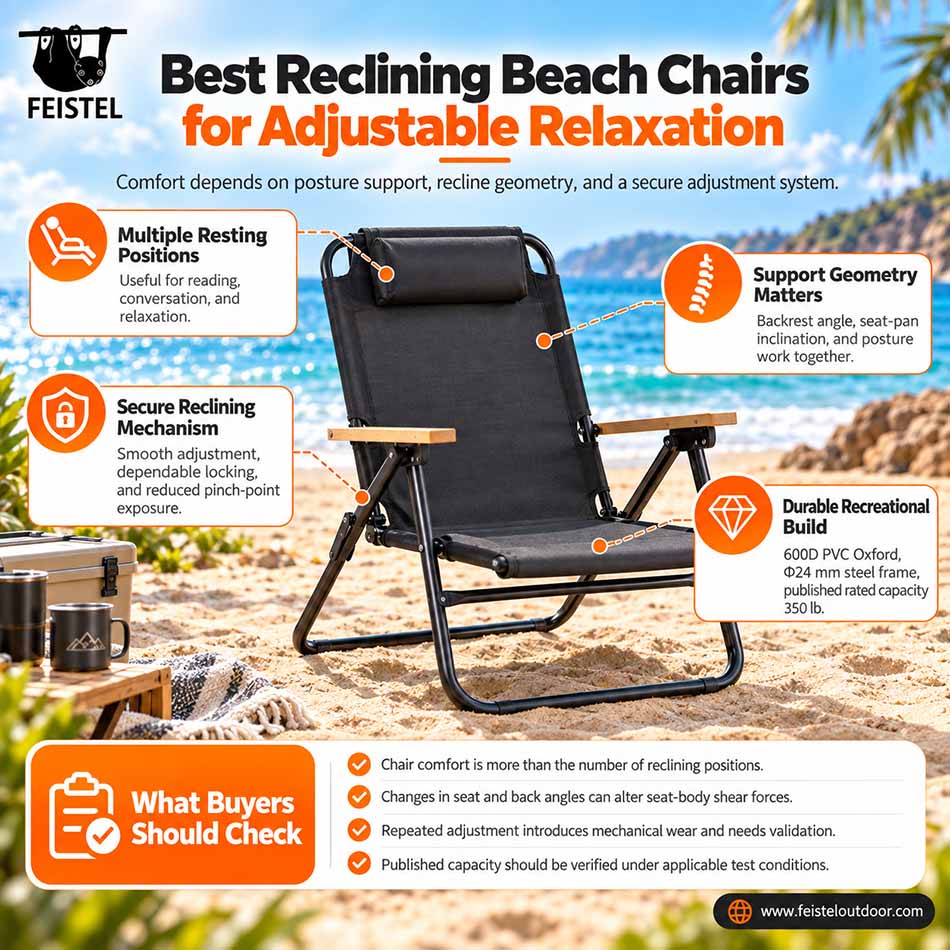
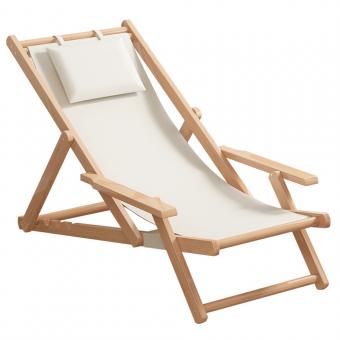
Wooden beach chairs provide a furniture-inspired visual character that can complement resorts, gardens, terraces, and coastal recreation settings. Their appeal includes natural textures, folding structures, armrests, and the possibility of coordinated fabric finishes.
Wood is not automatically weatherproof or environmentally superior. Its behavior depends on species, moisture content, finishing, joints, cleaning, and maintenance. For commercial use, buyers should also consider replacement components and the ease of inspection.
Our Folding Wooden Camping Chair – Adjustable Beach Reclining Lounge Chair with Armrests & Pillow illustrates a folding wooden lounge configuration with reclining adjustment and comfort accessories. Exact dimensions, weight, materials, and rated capacity should be confirmed for the selected current production configuration.
Lifecycle-assessment research on wooden furniture provides a useful method for evaluating sourcing, production, transport, use, and end-of-life stages. It does not prove that an individual wooden beach chair has a lower environmental impact than a metal alternative. [12]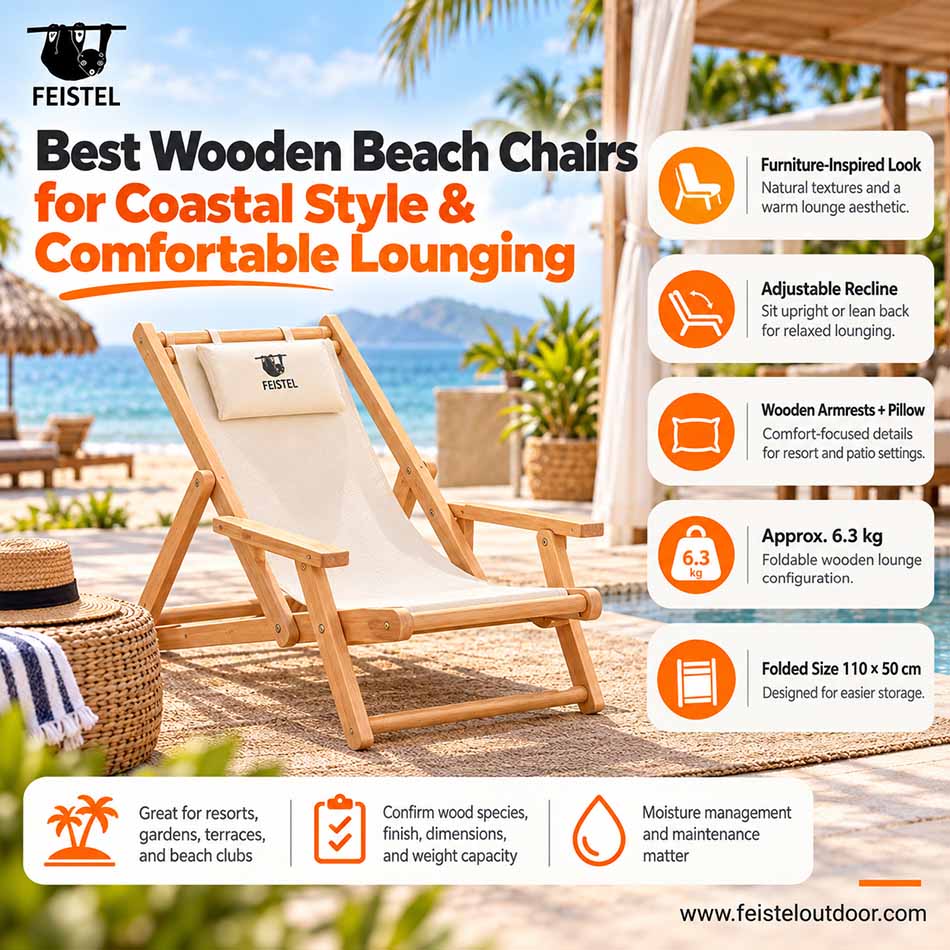
Low-profile chairs position the seat closer to the sand and may suit relaxed lounging and compact travel. However, the lower posture can demand greater knee and hip movement when users sit down or stand up.
Biomechanics research comparing 20, 40, and 60 cm seats has found meaningful differences in sit-to-stand movement, including greater demands associated with low seating for older participants under the examined conditions. This supports considering seat height in purchasing decisions, but not the idea of one universally optimal height. [3]
We recommend evaluating low-profile beach chairs in relation to the user's flexibility, activity, lower-leg dimensions, and need for easy standing. Flexible seating fabric can deflect under load, so unloaded seat height may not describe the actual occupied position.
High-back beach chairs provide a taller supporting surface than short-back designs and may be preferred for reading or extended sitting. Yet the label high-back does not guarantee head or neck support for every person.
Backrest performance depends on height, angle, shape, fabric tension, and the position of any pillow. A tall backrest may be poorly fitted to a user with different body proportions.
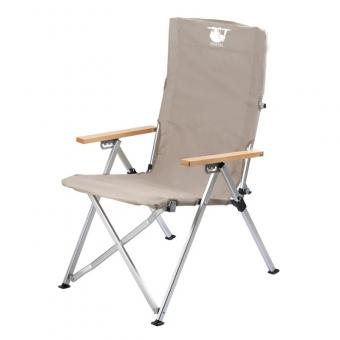
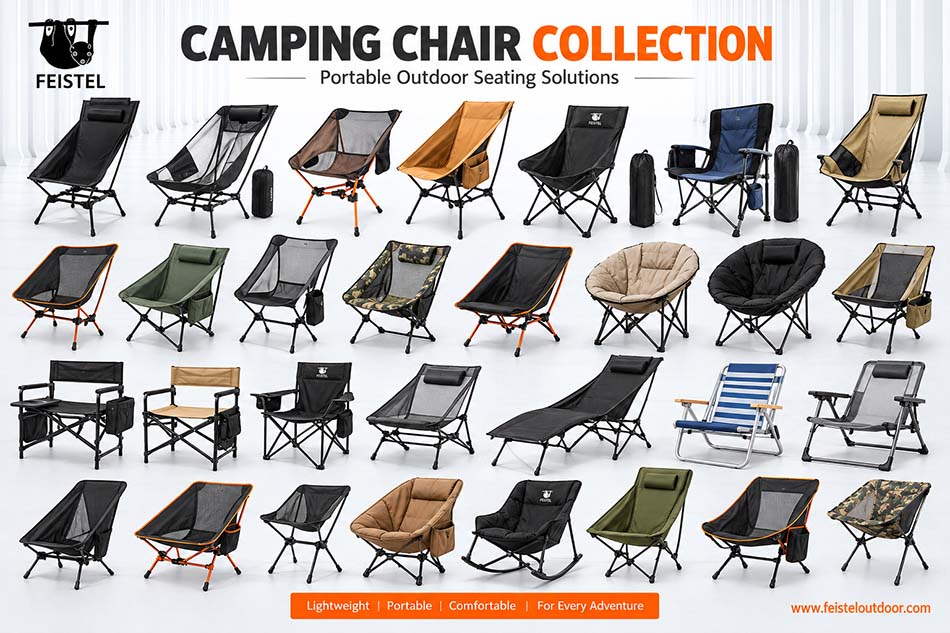
Our camping-chair collection includes taller portable seating designs. Buyers considering these for beaches should separately assess foot geometry and soft-sand stability. Taller backrests also present more area to coastal winds when unoccupied, making secure placement important.
There is no single chair design suitable for every older adult. Users vary widely in mobility, strength, height, body proportions, and seating preferences. We therefore focus on fit and accessibility rather than age-based marketing labels.
Published sit-to-stand research indicates that seat height, inclination, cushioning, backrests, and armrests can affect the ease of rising. A higher seat may reduce the required movement for some individuals, but the appropriate height should be assessed relative to leg dimensions and personal mobility. [2]
Armrests should not automatically be considered certified mobility aids. Their structural strength and intended loading must be checked.
On the beach, sinking and uneven support can further complicate standing. We recommend predictable ground placement, secure foot contact, appropriate seat firmness, and straightforward folding mechanisms.
Usable seat width differs from overall chair width because frames and armrests may occupy part of the advertised dimensions. Seat depth, backrest height, and armrest clearance should also match the intended user.
A high weight-capacity claim does not guarantee ergonomic fit. Nor does it establish repeated-impact durability without the relevant test procedure. Buyers should compare seating geometry and verify the claim under documented conditions.
Research on passenger-seat comfort demonstrates that human characteristics, seat design, and context interact. We apply the same general principle to outdoor seating: no one size or capacity figure guarantees comfort for every person. [4]
Compact folding chairs help travelers, apartment residents, and campervan owners manage limited storage. Some models fold flat into relatively long packages; others use detachable poles that pack shorter but require assembly.
The right choice depends on storage dimensions and setup preferences. Compactness should be evaluated using actual packed measurements, not a general product label.
Our folding camping-chair category contains compact aluminum designs with Oxford fabric and carrying configurations. Product weight, packed size, and capacities should be verified for the exact selected SKU and revision. Buyers should not sacrifice useful seat dimensions or appropriate sand contact purely to minimize package size.
Beach and camping chairs share portable frames, flexible seats, and folding mechanisms. Traditional beach chairs are often lower and more lounge-oriented, while camping chairs are often more upright and table-compatible. These are tendencies, not strict definitions.
A camping chair may be suitable for the beach when its feet, stability, materials, and instructions support sandy-ground use. Similarly, a beach-oriented chair may serve at parks or campsites.
We recommend comparing the actual structure and intended surfaces rather than assuming that the product category determines performance.
Seat height influences seated posture and the movement required to stand. A low chair may be attractive for relaxation, while a higher chair can be easier to use for some people who stand frequently.
Studies of older adults' chair-stand performance demonstrate the importance of seat height relative to lower-leg dimensions. This evidence favors individual fit over one universal measurement. [3]
We recommend specifying whether a measurement refers to an unloaded seat or a seat under a defined load. Textile seats may deflect when occupied, changing the effective seating position.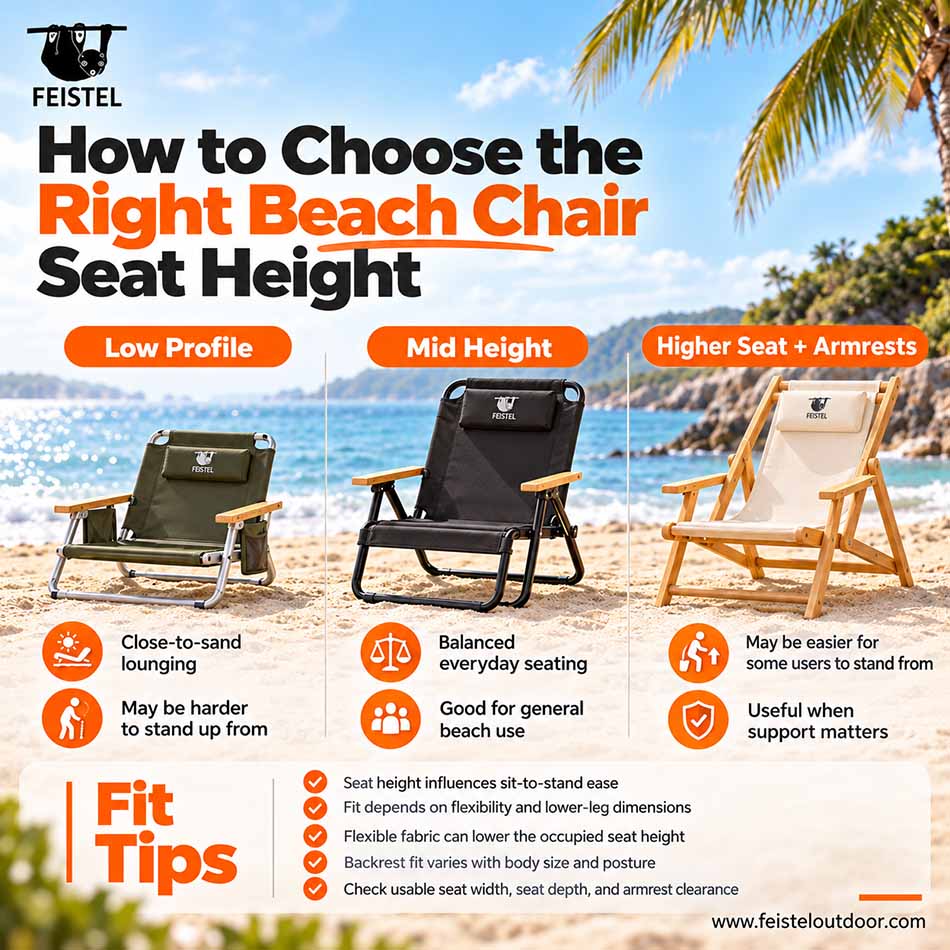
Comfort cannot be inferred from softness, padding, or backrest height alone. At FEISTEL, we consider seating comfort an interaction among body dimensions, posture, seat geometry, fabric support, environmental conditions, and duration.
A major ergonomics review found pressure distribution to be among the objective measurements associated with subjective discomfort, while emphasizing that subjective assessment remains necessary. Pressure data should complement, not replace, user feedback. [1]
Seat width influences lateral freedom, seat depth influences thigh support, and backrest inclination affects posture. Flexible fabric can conform to the body, but excessive sagging may make standing more difficult. Conversely, rigid edges and overly tight fabric may create localized pressure.
For commercial design programs, we recommend evaluation with representative users and consistent measurement procedures.
Frame materials offer different benefits and limitations. Aluminum alloys support lightweight construction, steel offers flexible design and manufacturing options, and wood provides a distinctive furniture-like appearance.
No material is universally superior. A chair's behavior depends on material grade, tube geometry, joint strength, coatings, fasteners, and overall design.
Marine-atmosphere research has documented pitting and other localized corrosion in several aluminum alloys, including 7075 under specified exposure conditions. High-strength aluminum should therefore not automatically be described as the most corrosion-resistant coastal option. [6]
Steel frames need suitable corrosion protection; wooden frames require attention to finishing, humidity, and joint behavior. Mixed-material structures also require compatible connections.
| Frame material | Advantages | Important checks |
|---|---|---|
| Aluminum alloy | Weight-conscious structural design | Alloy, finish, joints, corrosion |
| Steel | Manufacturing flexibility | Coating, welds, load performance |
| Wood | Classic furniture appearance | Species, finish, moisture, joints |
Outdoor chair fabric contributes to comfort, appearance, support, weathering, and cleaning. The designation 600D refers to yarn linear density, not a complete fabric durability rating.
Tensile strength, tear resistance, abrasion performance, seam strength, colorfastness, and UV aging depend on the specific textile construction, yarn, coating, stitching, and finish.
Polyester can be suitable for outdoor seating, but its performance is specification-dependent. Mesh openings may facilitate airflow, although actual thermal comfort also depends on wind, chair geometry, and clothing. Padding can soften contact but may affect drying and packed volume.
Research on textile weathering indicates that ultraviolet exposure and environmental conditions can degrade materials. Results from unrelated textile samples must not be presented as the predicted degradation of a FEISTEL chair. [8]
We separate three aspects of sand stability: resistance to sinking, sliding, and tipping. These are distinct properties.
Under simplified conditions, average contact pressure equals applied force divided by effective contact area (p = F / A). Increasing contact area may reduce average pressure at a comparable load, but does not guarantee that a chair will not sink.
Sand particle characteristics, moisture, compaction, foot geometry, support footprint, and user movement all matter. Reclining can alter the combined center of mass and tipping behavior.
Granular-soil foundation research provides a physical basis for these considerations, but does not replace product testing on representative beach surfaces. [7]
A portability comparison should record full carrying weight, packed dimensions, shape, carrying method, and setup complexity. A slightly heavier chair may still be easier to transport if its strap and packed form are better suited to the trip.
Buyers should distinguish the chair's bare weight from the complete transport configuration, including any bag or detachable accessories. We recommend testing the carrying experience over realistic distances instead of relying on a lightweight label.
Durability is a system-level characteristic involving frames, joints, coatings, textiles, seams, hinges, and fasteners. A chair that withstands one static load may still experience wear or fatigue under repeated use.
Environmental aging adds further complexity. UV radiation, temperature, humidity, salt, and abrasive particles can affect materials over time. Accelerated-aging research is useful for studying mechanisms, but does not directly establish a guaranteed number of years for an individual chair. [9]
We recommend linking durability claims to specific test conditions, approved product configurations, and relevant documentation.
Salt-containing moisture can reach frames, fasteners, and moving joints even when chairs are not immersed in seawater. Aluminum forms a protective oxide layer but can still experience localized corrosion. Steel usually needs suitable protective treatments, and different metals used together may introduce compatibility concerns.
Marine corrosion research demonstrates that alloy microstructure and exposure conditions influence corrosion behavior. We use that evidence to inform material discussions, not to assign untested service-life predictions to our products. [6]
Cleaning compatible surfaces and drying components according to the product's instructions can help manage exposure. We recommend inspecting joints and fasteners rather than assuming that the main frame material protects every component.
Thermal comfort depends on fabric permeability, air movement, solar radiation, humidity, and body contact. Mesh may facilitate airflow, but this does not guarantee a cooler experience in every environment.
Textile thermal-resistance and solar-reflectance research supports considering material structure and optical behavior when designing outdoor seating. Those studies are not direct tests of FEISTEL chair temperatures. [10]
Padding, color, fabric coating, shade, and drying characteristics should be considered together. No chair material replaces appropriate sun protection.
Families transport chairs alongside towels, coolers, umbrellas, and other equipment. A combination of seating formats may better serve different ages and activities than one identical model for everyone.
We recommend practical carrying dimensions, straightforward setup, cleanable construction, and suitable placement on the intended ground. Folding joints and reclining mechanisms can create pinch points; adult chairs should not automatically be considered safe for unsupervised children.
Commercial chairs may undergo frequent deployment, cleaning, transport, folding, and storage. Resorts may prioritize a consistent visual appearance, while rental operators may place greater emphasis on handling durability and replacement components.
We recommend approved samples, defined specifications, consistent production controls, and scheduled inspections. Customized branding or materials should not compromise essential performance or maintenance requirements.
Cup holders, pockets, pillows, armrests, carrying bags, and sunshades can improve convenience, but each adds components, weight, cost, and potential maintenance needs.
A pocket is not necessarily waterproof. A head pillow only helps when positioned appropriately. Armrests should not be assumed to act as mobility aids. Sunshades provide variable coverage depending on sun angle and positioning.
We recommend features chosen for a clear user need rather than maximizing the accessory count.
A reclining chair supports an elevated seated position with adjustable backrest angles, while a beach mat lounger often combines a ground-level surface with a supported backrest. Both can serve relaxation, but they meet different accessibility and transport needs.
Our Portable Folding Lawn Camping Chair & Adjustable Reclining Beach Mat Lounger illustrates an extended ground-level design. Buyers should assess support, adjustment, fabric care, folded dimensions, and whether low-level access is appropriate for the user.
Specifications should distinguish chair weight, complete carrying weight, open size, usable seating space, loaded and unloaded seat height, folded dimensions, frame materials, and rated capacity.
A published load capacity requires interpretation within its documented test method. Static performance is not the same as repeated impact or fatigue resistance.
Metric and imperial conversions should be consistent: one kilogram is approximately 2.205 pounds and one inch equals 2.54 centimeters. Rounding should never exaggerate an approved performance rating.
| Information | Why it matters | Recommended verification |
|---|---|---|
| Net weight | Carrying convenience | Weigh approved configuration |
| Open size | Product footprint | Measure fully opened chair |
| Usable seat width | Body fit | Measure clear seating space |
| Folded size | Transport and storage | Measure packed configuration |
| Rated load | Structural requirement | Review appropriate test evidence |
| Frame and fabric | Performance and care | Confirm material specifications |
A practical assessment should include inspection, opening and folding, comfort, adjustments, carrying, intended-ground performance, and cleaning.
Inspect frame joints, textile attachments, hinges, fasteners, edges, and finishes. Check that folding and locking functions engage as intended. Evaluate seating dimensions with representative users, and examine how the chair behaves on permitted ground conditions.
This is a proposed evaluation procedure, not a claim that every chair mentioned in this article has undergone a completed identical comparative test.
A scorecard can organize comparisons, but no universal set of weights has been established for every consumer. As an illustrative starting point, we suggest comfort and fit at 25%, portability at 20%, ground stability at 20%, construction quality at 15%, ease of use at 10%, and maintenance and value at 10%.
These weights are editorial guidance rather than validated consumer-preference data. Buyers should adapt them according to their requirements, while treating safety and compliance requirements as mandatory conditions rather than tradeable scoring factors.
| Illustrative evaluation factor | Suggested weight |
|---|---|
| Comfort and ergonomic fit | 25% |
| Portability and packed dimensions | 20% |
| Ground stability | 20% |
| Construction quality | 15% |
| Ease of use | 10% |
| Maintenance and value | 10% |
Common errors include choosing solely by weight, ignoring seat height, assuming all aluminum alloys are corrosion-proof, treating 600D as a comprehensive durability rating, and interpreting static capacity as proof of long-term fatigue performance.
Other mistakes include assuming that every reclining chair lies flat and accepting unsupported service-life or environmental claims.
We recommend beginning with real user needs, then comparing dimensions, materials, folding functions, ground suitability, and documented test evidence.
Cleaning should follow the manufacturer's instructions. Loose sand may be removed from accessible surfaces and joints, and compatible components may be cleaned to address salt residues.
Cleaning products and methods must suit the specific frame finish and textile construction. Damp materials should not be sealed away for long-term storage without appropriate drying.
During cleaning, inspect hinges, seams, fasteners, and any visible corrosion or structural damage. Chairs with compromised structural components should not continue in use.
Storage in protected conditions can reduce unnecessary exposure. We recommend removing dirt and sand, following appropriate drying procedures, and avoiding loads or stacking arrangements beyond the product's intended design.
Textiles may benefit from reduced unnecessary UV exposure, and wooden products may need special attention to moisture and finishing conditions. Good maintenance is beneficial, but we do not promise a quantified service-life extension without corresponding evidence.
Purchase price is not a direct measure of comfort or durability. Product value depends on the user's needs, frequency of use, maintenance, and total ownership costs.
A simple cost-per-use estimate divides total ownership cost by expected total uses. The denominator is an estimate unless supported by real service records. Commercial operators should also consider logistics, inspection, storage, repairs, and disposal.
We recommend transparent assumptions rather than guaranteed lifespan promises.
Sustainability depends on more than whether a frame is made of aluminum, steel, or wood. Responsible evaluation considers sourcing, manufacturing, transport, use, repair, and end-of-life treatment.
Research on product lifetime extension and furniture lifecycle assessment shows that environmental effects depend on the product system and replacement scenario. Longer life may reduce replacements, but does not automatically establish a precise environmental benefit. [11] [12] [13]
Repairable connections, replaceable textile components, efficient material use, and appropriate packaging can be considered during product development. Claims should be based on documented evidence and clearly defined system boundaries.
Modern beach chairs combine features once associated with different outdoor-furniture categories, including compact frames, reclining mechanisms, breathable panels, padded contact surfaces, and coordinated accessories.
Each improvement can create trade-offs. More features can increase weight and complexity, while aggressive weight reduction may affect structure and comfort.
At FEISTEL, we regard innovation as useful when it addresses a real user problem and remains practical to manufacture, operate, test, and maintain.
Dry sand, wet sand, pebbles, grass, decks, and mixed terrain provide different supporting conditions. A chair stable on concrete may move or sink on granular surfaces.
We recommend evaluating ground-contact design and chair geometry on the actual intended surfaces. Broad labels such as all-terrain or sandproof should be supported by relevant evidence rather than assumed from appearance.
Vehicle travelers may accept larger folding chairs, while campervan users and public-transport passengers may prioritize compact packed dimensions. For walking trips, shape and carrying method can matter as much as mass.
Buyers should compare packed sizes with actual storage spaces, evaluate carrying systems, and consider setup requirements. A multi-purpose chair may replace several specialized products only when it is suitable for all intended environments.
Beach chairs are load-bearing products with moving mechanisms. Users should observe the manufacturer's rating, place the chair on suitable ground, inspect visible components before use, and ensure folding systems are fully engaged.
Avoid sudden impacts, standing on chairs, and handling hinges without attention to pinch points. In strong winds, lightweight unoccupied chairs may need secure storage.
Clear instructions and warnings are important for both individual and commercial seating programs.
Product quality depends on material consistency, dimensions, connections, fabric construction, load-bearing performance, finishing, and functional operation.
A validation plan may include incoming materials inspection, dimensional checks, static loading, repeated-use performance, seam and textile evaluation, environmental resistance, and final inspection.
Testing must use methods appropriate to the exact design and destination market. A certificate applicable to one configuration does not automatically cover different customized versions.
Wholesale sourcing requires an agreed target customer, product specification, sample approval, quality criteria, logistics plan, and customization scope.
Different markets may prioritize different characteristics: a resort lounger may emphasize appearance and maintenance, while a travel chair may emphasize low carrying weight and packed size.
We recommend establishing relevant performance requirements and inspection conditions before mass production rather than relying only on product images or price.
OEM programs commonly follow an agreed design or sample specification, while ODM work may involve broader development of structures, dimensions, materials, and product features.
At FEISTEL, our publicly described customization services include structure, dimensions, fabrics, colors, logos, accessories, and packaging. Structural modifications can change loading and stability, so the final approved configuration should govern testing and inspection.
Successful projects begin with a clear intended user and market requirement, then proceed through feasibility review, sampling, approval, and controlled production.
We approach outdoor seating by considering the environment and intended user before selecting technical features. Lightweight travel chairs demand a different balance of geometry, storage, and weight from wooden lounge chairs or commercial rental seating.
Academic research helps explain ergonomics, corrosion, textile aging, and sand mechanics. Product pages communicate available configurations and specifications. Testing and inspection establish specific performance only where the relevant evidence exists.
We do not present general research or marketing language as proof that one FEISTEL model is better than every competing chair.
Beach chair design intersects human-factors research, biomechanics, materials engineering, corrosion science, textile thermal behavior, and granular-soil mechanics.
Published studies help explain why seat height influences standing, why pressure distribution can contribute to discomfort, why aluminum alloys differ in coastal corrosion resistance, and why sand contact is affected by geometry and soil properties.
However, experiments on office seats, vehicle chairs, metal specimens, textiles, or foundations do not independently establish how a complete FEISTEL beach chair will perform. We distinguish general scientific principles from product specifications and verified product-level tests.
The most appropriate chair depends on the user, intended activities, ground conditions, seating dimensions, portability, and maintenance requirements. There is no universal best choice.
Not for everyone. A low chair can suit relaxed lounging but may make standing more difficult for some users.
Aluminum, steel, and wood can all be appropriate. The full construction, finish, and intended environment determine suitability.
Aluminum does not rust like steel but can undergo other forms of corrosion, including localized corrosion in marine conditions.
Some can, provided the feet, materials, stability, and instructions suit beach use.
No. Denier alone does not establish tensile strength, tear resistance, abrasion performance, or environmental durability.
They can reduce average contact pressure in some conditions, but stability also depends on sand properties, footprint, geometry, and loading.
Seat height, stability, support, ease of standing, and individual fit are important.
FEISTEL discusses OEM/ODM options for structure, dimensions, materials, fabrics, colors, logos, and packaging, subject to feasibility and approval.
No. This article is a research-informed design and buying guide using FEISTEL examples, not a completed market-wide laboratory comparison.
The best beach chairs balance comfortable fit, practical portability, appropriate ground stability, durable construction, and maintenance requirements. None of these characteristics should be assessed independently of intended use.
Lightweight folding designs help with transport; low-profile chairs suit certain relaxing postures; higher seats may assist users who prefer easier standing; and reclining chairs provide adjustable positions when their mechanisms are well designed.
Aluminum, steel, and wooden frames each have relevant advantages and limitations. Coastal use requires attention to actual alloy, finishing, fasteners, textiles, sand contact, and maintenance.
For individual buyers, we recommend prioritizing real body dimensions and activities. For brands and wholesale customers, we recommend accurate specifications, approved samples, quality controls, and tests applicable to the final configuration.
At FEISTEL, our aim is to explain the underlying principles and provide suitable outdoor-seating options without overstating unverified performance claims.
These studies explain general research principles. They are not independent laboratory verification of any FEISTEL chair model.
カテゴリ
ブランド:安徽省FEISTEL FACTORY 関連製造: OEM & ODM 商品名:アウトドアに最適な軽量、小型、折りたたみ可能なピクニックテーブル。耐久性のある素材で作られており、持ち運びが簡単で、セットアップも簡単です。
ブランド : 安徽省ファイステル工場 製造業の関連 : OEMとODM 製品 : カスタム軽量メタルアイアン折りたたみ式ムーンチェアは、耐久性のあるサポートと快適さを提供し、屋外キャンプに最適で、持ち運びや保管が簡単なコンパクトでポータブルなデザインです。
ブランド:安徽省FEISTEL FACTORY 関連製造: OEM & ODM 製品:アウトドアポータブル折りたたみロールアップピクニックテーブル:高さ調節可能、セットアップが簡単、キャンプ、ピクニック、アウトドアアクティビティ用のコンパクトなキャリーバッグを備えた軽量で耐久性のあるアルミニウムデザイン。
ブランド:安徽省FEISTEL FACTORY 関連製造: OEM & ODM 商品名:高さ調節可能な脚が付いた、多用途でポータブルな IGT BBQ キャンプテーブル。アウトドアクッキング、キャンプ、ピクニックなどに最適です。軽量で折りたたみ可能で持ち運びが簡単です。
ブランド:安徽省FEISTEL FACTORY 関連製造: OEM & ODM 商品名:キャンプやビーチ、アウトドアなどに最適な、コンパクトで軽量なアルミ製折りたたみテーブルです。持ち運びが簡単で丈夫なので、食べ物や飲み物を入れるのに最適です。
ブランド : 安徽省ファイステル工場 製造業の関連 : OEMとODM 製品 : このキャンプ用折りたたみ式木製ラウンジチェアは、頑丈なフレーム、人間工学に基づいたリクライニング デザイン、コンパクトな折りたたみ構造を特徴としており、ビーチ、キャンプ場、裏庭でのリラックスに最適です。
ブランド : 安徽省ファイステル工場 製造業の関連 : OEMとODM 製品 : この屋外用折りたたみアルミフレーム キャンプ チェアは、調節可能な背もたれと軽量ながらも丈夫なデザインが特徴で、キャンプ、ビーチ旅行、ピクニック、屋外でのリラックスに持ち運びやすく快適です。
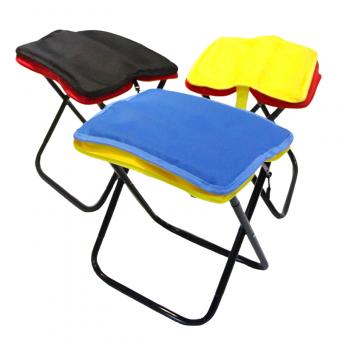
ブランド : 安徽省フェイステル工場 製造業と関連 : OEMとODM 製品 : ハイキング用バックパッキング ミニ スツールは、耐久性のあるオックスフォード生地の折りたたみ式デザインとクリエイティブなペンケース ポケットを組み合わせ、キャンプやアウトドア アドベンチャーに携帯性、快適性、実用性を提供します。
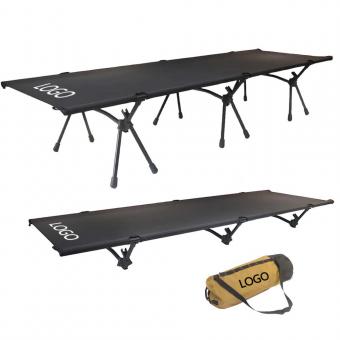
ブランド : 安徽省ファイステル工場 製造業の関連 : OEMとODM 製品 : 卸売ハイキング用品旅行用寝具は、高さ調節可能な折りたたみ式キャンプ用簡易ベッドで、頑丈なサポート、持ち運びやすさ、屋外での冒険に快適な休息を提供します。
ブランド: ANHUI FEISTEL FACTORY 関連製造業: OEM & ODM 製品:耐久性のあるフレーム、簡単なセットアップ、旅行に便利なキャリーバッグを備え、バックパッキングに最適な屋外用超軽量シングルコンパクトポータブル折りたたみキャンプベッドです。
接続を維持しましょう :